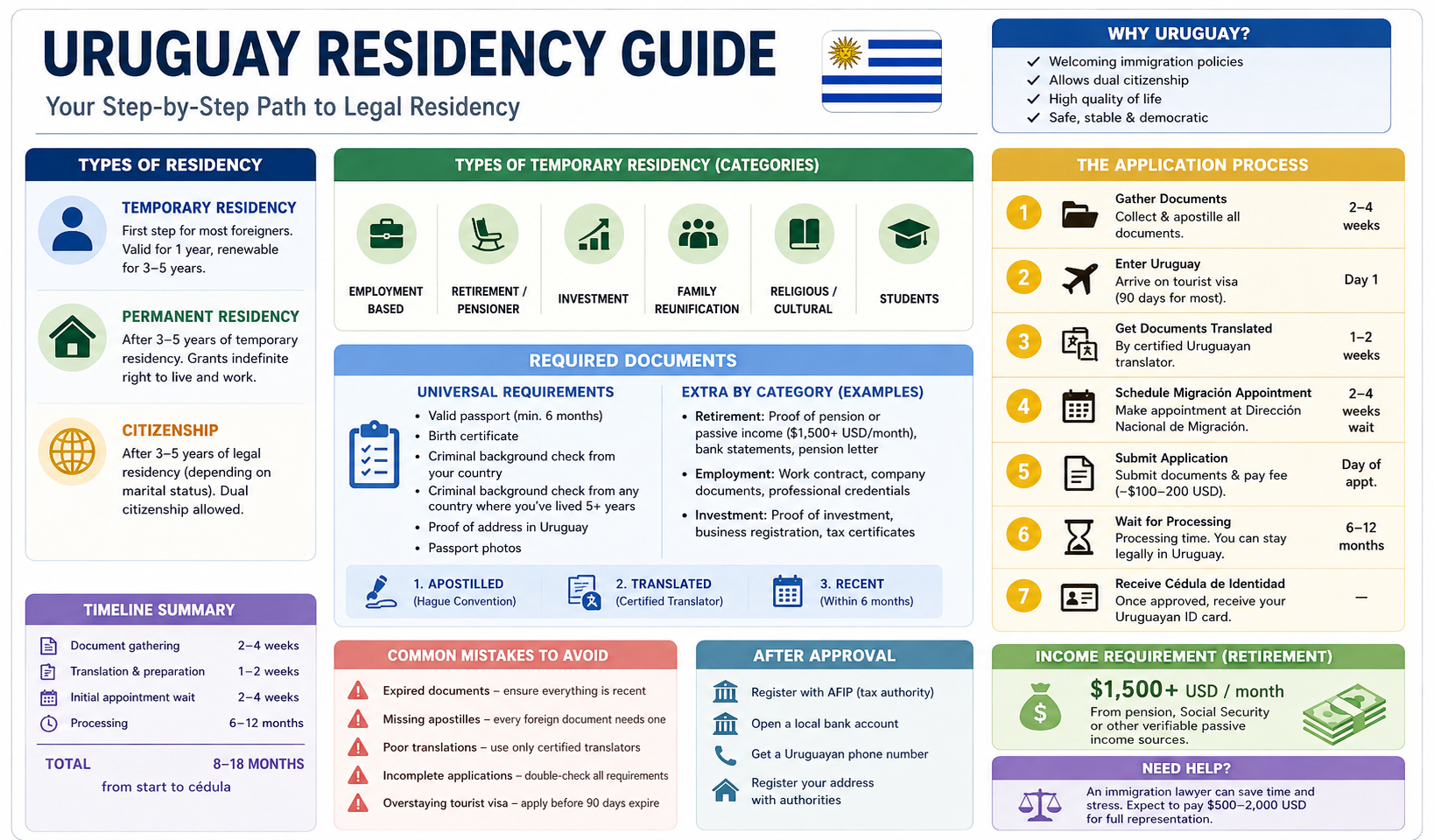
Overview of Uruguay's Residency System
Uruguay has one of the most welcoming immigration policies in South America. The country actively encourages foreign residents and offers multiple pathways to legal status.
Understanding the system before you begin will save time and frustration. This guide walks you through every step of the process.
Types of Residency
Temporary Residency (Residencia Temporal)
This is the first step for most foreigners. Temporary residency is valid for one year and must be renewed annually for the first three to five years.
Categories include:- Employment-based
- Retirement/pensioner
- Investment
- Family reunification
- Religious or cultural workers
- Students
Permanent Residency (Residencia Definitiva)
After maintaining temporary residency for 3-5 years (depending on your category), you can apply for permanent residency. This grants indefinite right to live and work in Uruguay.
Citizenship
After 3-5 years of legal residency (depending on marital status), you can apply for Uruguayan citizenship. The country allows dual citizenship.
Required Documents
All documents from your home country must be:
Universal Requirements
- Valid passport (minimum 6 months validity)
- Birth certificate
- Criminal background check from your country
- Criminal background check from any country where you've lived 5+ years
- Proof of address in Uruguay
- Passport photos
Category-Specific Documents
For Retirement:- Proof of pension or passive income ($1,500+ USD/month)
- Bank statements
- Pension award letter
- Work contract with Uruguayan company
- Company registration documents
- Your professional credentials
- Proof of investment in Uruguay
- Business registration documents
- Tax compliance certificates
The Application Process
Step 1: Gather Documents (2-4 weeks)
Collect all required documents from your home country. Get them apostilled through your country's designated authority (usually Secretary of State or Foreign Affairs).
Step 2: Enter Uruguay
Arrive in Uruguay on a tourist visa (90 days for most nationalities). You'll complete the rest of the process in-country.
Step 3: Get Documents Translated
Take your apostilled documents to a certified translator (traductor público). This typically costs $20-50 per document.
Step 4: Schedule Migración Appointment
Make an appointment at the Dirección Nacional de Migración. Wait times vary but expect 2-4 weeks.
Step 5: Submit Application
At your appointment, submit all documents and pay the application fee (approximately $100-200 USD). You'll receive a receipt confirming your application.
Step 6: Wait for Processing
Processing takes 6-12 months. During this time, you can stay legally in Uruguay. Check your status online periodically.
Step 7: Receive Cédula de Identidad
Once approved, you'll receive your Uruguayan identity card (cédula). This is your official residency document.
Working with Immigration Lawyers
While not required, an immigration lawyer can:
- Navigate bureaucratic complexities
- Ensure documents are properly prepared
- Handle communication with authorities
- Speed up the process in some cases
Expect to pay $500-2,000 USD for full representation.
Common Mistakes to Avoid
After Approval
Once you have residency, you'll need to:
- Register with AFIP (tax authority)
- Open a local bank account
- Get a Uruguayan phone number
- Register your address with authorities
Timeline Summary
- Document gathering: 2-4 weeks
- Translation and preparation: 1-2 weeks
- Initial appointment: 2-4 weeks wait
- Processing: 6-12 months
- Total: 8-18 months from start to cédula