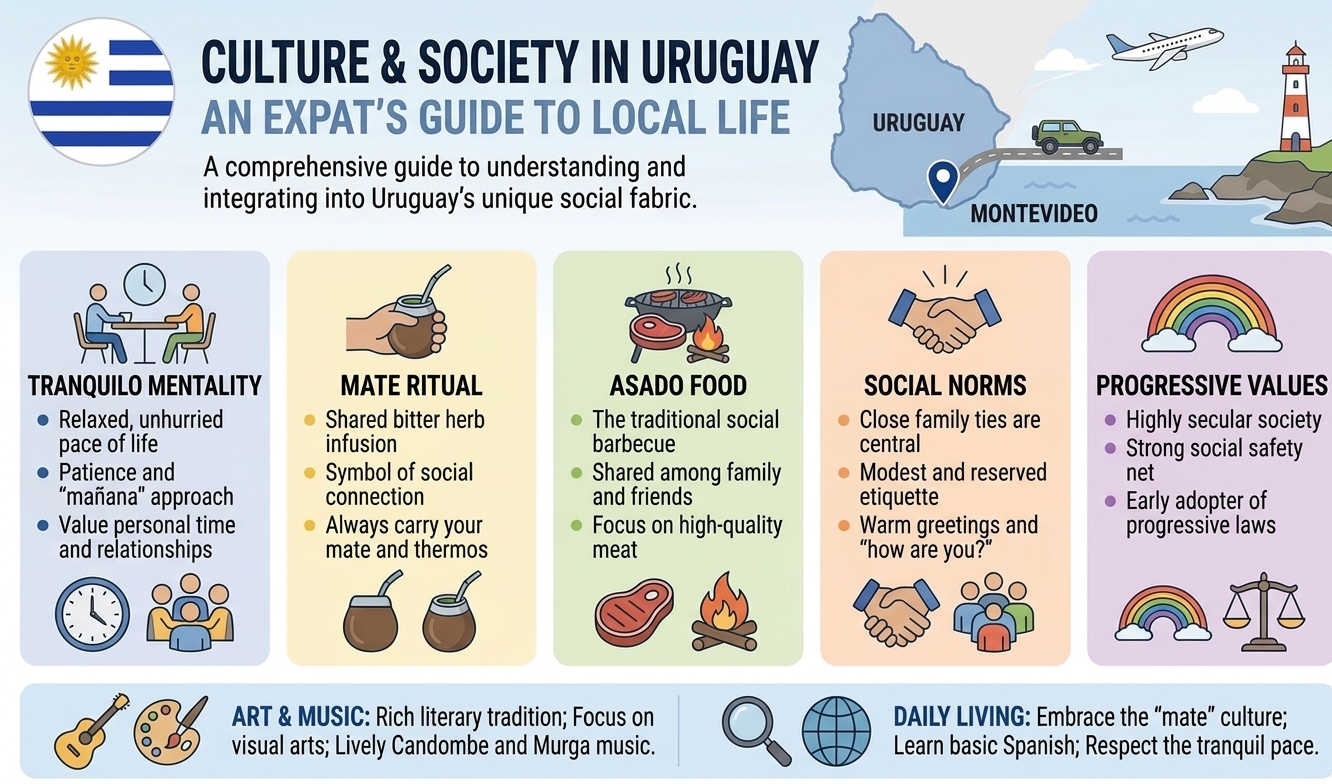
Understanding Uruguayan Culture: An Overview
Uruguay often gets described as "the Switzerland of South America" — stable, democratic, and a little understated. That reputation is earned. But it doesn't capture what daily life here actually feels like, or what it means to integrate into Uruguayan society as a foreigner.
The people of Uruguay are shaped by a history of immigration (mostly Spanish and Italian), a strong civic tradition, and a geography that keeps things small and manageable. With just 3.5 million people — nearly half of them in Montevideo — it's a country where things feel personal. The president takes the bus. The neighbour knows your name. Social equality isn't just a political value; it's embedded in how people interact.
For expats, this culture is generally easy to appreciate — but it takes time to actually enter. Here's what you need to understand.
---
The 'Tranquilo' Mentality
The single most important cultural concept for any new arrival is tranquilo — literally "calm" or "relax," but used as a full philosophy of life.
Uruguayans don't rush. Services are slow. Lines are long. Government processes take months. This isn't inefficiency (well, sometimes it is) — it's also a deliberate cultural stance. Life isn't meant to be optimised. The evening walk along La Rambla, the Sunday asado that stretches into night, the mate circle that pauses any meeting — these aren't interruptions to productivity. They are the point.
For expats coming from high-pace cultures — the US, UK, northern Europe — the adjustment takes several months. Expect frustration early on. Expect genuine appreciation later. Most long-term expats say the tranquilo pace is one of the main reasons they stayed.
Practical implications:
- Punctuality is loose. Arriving 15-30 minutes late to social events is normal and expected.
- Don't interpret slow responses to emails or messages as rudeness.
- Government offices, banks, and service providers operate at their own tempo. Plan extra time.
- Sundays are genuinely quiet. Many businesses close or run reduced hours.
---
Mate: The Social Ritual You'll Need to Understand
If you spend any time in Uruguay, you will encounter mate constantly. People carry thermoses in the crooks of their arms on morning commutes. Offices have a designated mate break. Construction workers pause mid-job to share a round. It is, without exaggeration, the central social ritual of Uruguayan daily life.
Mate is made from the dried leaves of the Ilex paraguariensis plant, steeped in a small gourd with hot (not boiling) water and sipped through a metal filter straw called a bombilla. The gourd is refilled continuously with water from a thermos and passed around a group — each person sipping until the water is gone, then handing it back to the cebador (the person preparing the mate) to refill.
What expats need to know:The ritual has its own etiquette. The cebador prepares and serves each round, always drinking first to test the temperature. You don't add sugar unless offered (and some Uruguayans are purists who consider sweetening it a minor offence). You say gracias when you've had enough — this signals you're done. Passing the gourd back without drinking is rude.
Being offered mate from someone's personal gourd is a meaningful gesture. It signals you're trusted, included, part of the circle. Accepting — even if you only take a polite sip — is the right social move.
You don't have to like mate. Many expats never do. But understanding what it means matters far more than the taste.
---
Asado: Food, Fire, and the Social Fabric
Asado is more than a barbecue. In Uruguay (as in Argentina), it's a social institution — the primary context in which friendships deepen, families gather, and weekends are structured.
Uruguayan asado differs slightly from Argentine. Uruguayans prefer cooking over wood embers (brasa) rather than charcoal, and they tend toward longer, slower cooking. The cuts are generous: tira de asado (short ribs), vacío (flank), chorizo, and morcilla (blood sausage). Quality beef is cheap and excellent — Uruguay is one of the world's top beef exporters, and it shows at the table.
If you're invited to an asado, bring wine, beer, or something for dessert. Arrive expecting to stay for hours. The social pace is deliberately slow: drinks and conversation come before the meat, not alongside it. The asador (grill master) commands the timeline and should never be rushed.
As an expat, getting invited to a local's asado is a milestone. It means you've moved past the polite-acquaintance stage.
---
Social Norms and Uruguayan Personality
Reserved, Not Cold
Uruguayans are often described as more reserved than other Latin Americans. They don't effusively greet strangers, and they're unlikely to pry into your life or invite you somewhere after a first meeting. This can feel unfriendly to expats used to more open cultures.
It isn't. Uruguayan warmth is earned slowly and lasts longer for it. The social circle you eventually build here will be genuinely close. People are loyal, reliable, and private in a way that many expats come to deeply respect.
Greetings and Physical Contact
Among friends and acquaintances, the standard greeting is a single kiss on the right cheek — for any gender combination. Handshakes are more formal, used in professional settings or when meeting someone for the first time in a business context. As you get to know people, the kiss becomes standard.
Directness Without Aggression
Uruguayans tend to be direct but not confrontational. They'll say what they think, but without the performative enthusiasm or salesmanship common in some cultures. Flattery and excessive positivity can actually read as suspicious. Honest, low-key communication is appreciated.
Egalitarianism in Practice
Class distinctions exist, but Uruguayan culture strongly resists flaunting them. Ostentatious wealth is looked down on. People across income levels shop at the same markets, use the same hospitals (by choice, not just necessity), and send their kids to public schools. The ex-president José Mujica famously lived on a farm and donated 90% of his salary to charity. This wasn't an anomaly — it was popular because it resonated with deeply held values.
---
Secular Society and Progressive Values
Uruguay is the most secular country in Latin America. Church and state were formally separated in 1919 — decades before most of Europe. Religious holidays were officially renamed: Christmas became "Family Day," Easter became "Tourism Week."
Religion is present, but private. Most Uruguayans identify as non-religious or culturally Catholic. You'll rarely hear religious references in casual conversation, and faith plays essentially no role in politics.
This secularism connects to Uruguay's broader progressive social record. Same-sex marriage was legalised in 2013. Cannabis was legalised and regulated by the state in 2013. Abortion is legal and publicly funded. Gender identity laws are among the most progressive in the Americas.
For expats from more conservative backgrounds, this may be a cultural adjustment. For those from liberal urban environments, it often feels immediately comfortable.
---
Work Culture and Professional Life
Hours and Expectations
The standard working week is 40 hours, and this is generally observed. Overtime culture is limited. Lunch breaks are real — often 30-60 minutes, and sometimes longer for those who go home. In smaller towns, the midday siesta pause still exists.
Government offices, banks, and many public services have reduced afternoon hours. Some close entirely between 1pm and 4pm. Plan your errands accordingly.
Formality and Hierarchy
Uruguayan workplaces lean informal. First names are used almost universally. Management styles tend toward collaborative rather than hierarchical, especially in tech, creative industries, and startups (Montevideo has a growing tech sector). In more traditional industries — law, finance, government — expect more formality.
Tech and Remote Work
Uruguay punches above its weight in technology and startup culture, relative to its size. Plan Ceibal (which gave every schoolchild a laptop as early as 2007) is a marker of the country's long-term investment in tech education. Montevideo has solid infrastructure, fast internet, and a growing community of remote workers and digital nomads. The Zona Franca (free trade zone) houses international companies, and English proficiency is higher in this sector than elsewhere.
---
Art, Music, and Cultural Life
Tango and Candombe
Tango is shared between Uruguay and Argentina — Montevideo claims a significant part of its origin. The style that emerged here (tango orillero) was rawer and more improvised than the Buenos Aires form. Milongas (tango social dances) happen weekly in Montevideo.
Candombe is distinctly Uruguayan — a drum-based music and dance tradition descended from enslaved Africans brought to the Río de la Plata region. The tamborileros (drummers) march through Montevideo neighbourhoods on Sunday afternoons, and during Carnaval — which Uruguay celebrates with more intensity than almost anywhere in the world — candombe is everywhere. It's worth experiencing early in your time here.
Carnaval
Uruguay's Carnaval runs for nearly 40 days from late January to early March, making it one of the longest in the world. The central event is the desfile de llamadas — a massive parade of candombe drummers that shakes the streets of Montevideo's Palermo and Sur neighbourhoods. Murgas (satirical musical theatre troupes) perform at the Teatro de Verano and across the city. This is not a tourist event — it's a genuine cultural moment that most Uruguayans take seriously.
Literature and Football
Two cultural obsessions: books and football. Uruguay has a strong literary tradition — Eduardo Galeano (Open Veins of Latin America, Football in Sun and Shadow) is the most internationally recognised writer. Libraries and bookshops are well-used and well-stocked.
Football (soccer) is a near-religion. Uruguay won the first World Cup in 1930, and the national team — La Celeste — remains a source of intense national pride disproportionate to the country's size. Match days in Montevideo feel different. If you want an easy way to connect with people, knowing something about Uruguayan football history is more useful than knowing tango steps.
---
Language: What You Actually Need
Spanish is spoken by everyone in Uruguay. The accent and vocabulary are close to Argentine Spanish — the most notable feature is voseo, using vos instead of tú (e.g., ¿Cómo estás? becomes ¿Cómo estás vos? or ¿Cómo te va?). Verb conjugations change accordingly.
English proficiency: Growing, but limited. In Montevideo's tech sector, Pocitos neighbourhood, and among younger professionals, you'll find English speakers. Outside this bubble — in government offices, medical appointments, neighbourhood shops, or smaller cities — Spanish is essential. For bureaucratic processes like residency, banking, and healthcare, you will need Spanish or a reliable interpreter.Practical recommendation: begin Spanish lessons before you arrive if possible, and commit to using it socially even when locals switch to English to help you. The faster you build conversational confidence, the faster you integrate.
---
Religion of Uruguay: A Practical Note for Expats
Uruguay's secular culture is welcoming to people of all religious backgrounds — and to those of none. You won't encounter social pressure around faith in either direction. Religious communities exist (Catholic, Jewish, evangelical Christian, and others), are organised, and can be a useful social network if faith is important to you. But don't expect religion to be a significant part of public social life or workplace conversation.
---
Adapting: A Realistic Timeline
Months 1-3: Everything is new and energising, but bureaucracy and language will frustrate you. Social connections are mostly with other expats. Mate tastes strange. Months 4-6: The pace starts to feel normal. You have a few local acquaintances. You've been to at least one asado. Spanish is improving. You know which shops close on Sunday. Months 7-12: You have a real social circle. You may have been invited to a local family gathering. You carry a thermos. You're explaining Uruguay to newly arrived expats. Year 2+: This feels like home in the specific way that Uruguay makes possible — unhurried, unpretentious, genuinely liveable.---
Summary: What Expats Love (and Find Hard) About Uruguayan Culture
What most expats come to love:- The genuine work-life balance and absence of hustle culture
- The social depth of relationships once formed
- The political stability and progressive social environment
- The food, especially the beef and the Sunday asado culture
- The sense of safety and civic trust
- The initial social reserve and slow pace of making local friends
- The bureaucratic pace across almost all services
- The essential role of Spanish in everything that matters
- Sunday closures and reduced hours broadly
- The mate learning curve (the taste, the etiquette, the thermos logistics)
Uruguayan culture rewards patience and genuine engagement. Expats who integrate most successfully are those who come curious rather than comparative — interested in understanding this place on its own terms rather than measuring it against where they came from.
---
For practical next steps, see our guides on [moving to Uruguay](/guides/moving-to-uruguay), [living in Montevideo](/guides/living-in-montevideo), and [choosing the best city for your lifestyle](/guides/best-cities-to-live-in-uruguay).