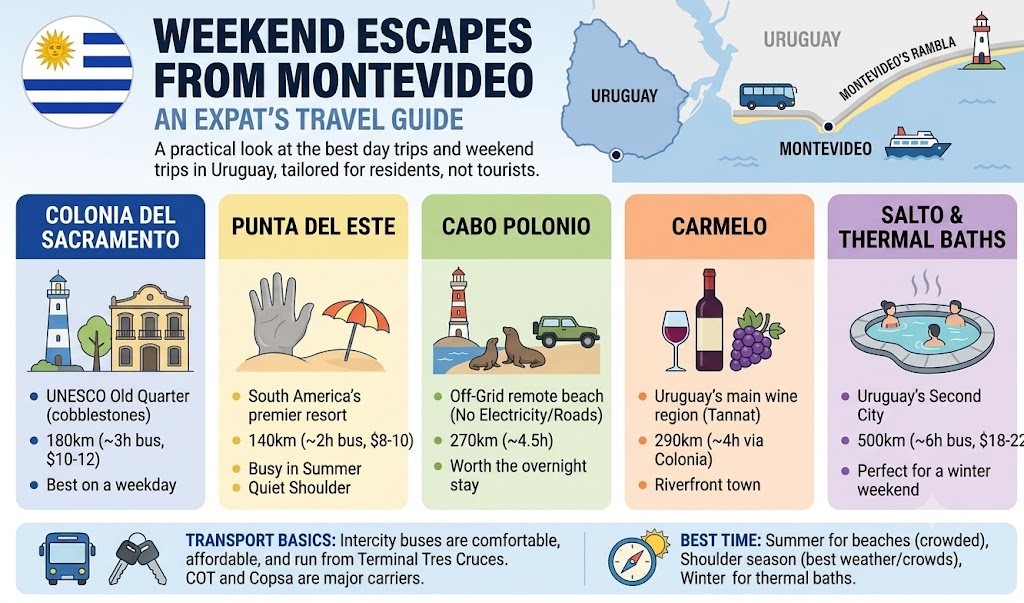
Getting Out of Montevideo: What Residents Actually Do
Montevideo is liveable in a way that makes it easy to stay put. The rambla, the markets, the neighbourhood ferias, the asados — there's a rhythm to city life that can fill weekends without effort.But Uruguay beyond Montevideo is worth knowing. The country is small enough that major destinations are accessible in a few hours, and the intercity bus network — operated by companies like COT, Copsa, and Turil — is reliable, affordable, and nothing like the bus experiences in larger Latin American countries. Air-conditioned coaches, assigned seats, on-time departures.
This guide is written for people who live in Montevideo, not those visiting for a week. That means honest assessments of what's worth the trip, seasonal advice, and the transport logistics that actually matter when you're doing this regularly rather than ticking off a checklist.
---
Transport Basics Before You Go
Terminal Tres Cruces is Montevideo's main bus terminal, well-organised with a food court, luggage storage, and easy taxi/Uber access. Almost all intercity buses depart from here. Booking: You can buy tickets at the terminal on the day for most routes, though Friday evenings and summer weekends to Punta del Este sell out. COT and Copsa have online booking. Redbus Uruguay aggregates most carriers. Prices: Uruguay's buses are inexpensive by Southern Cone standards. Montevideo - Colonia runs around $10-12 USD each way. Montevideo-Punta del Este is around $8-10 USD. Even the longer routes to Salto or Tacuarembó rarely exceed $25 USD. Having a car: Not necessary for the destinations in this guide, but opens up wine routes around Carmelo, back roads through the Rocha wetlands, and rural stops that buses don't serve. Rental is straightforward from Montevideo's airport or city centre.---
Colonia del Sacramento
Distance: ~180km west | Bus: ~3 hours, $10-12 USD | Best for: First-time visitors, history, a slow afternoonColonia del Sacramento is the day trip most Montevideo residents will do first and recommend most often. It's the right size for a day — compact, walkable, historically interesting without being demanding — and the UNESCO-listed Barrio Histórico (old quarter) is genuinely one of the prettiest corners in the Río de la Plata region.
The old town sits on a small peninsula: cobbled streets, Portuguese-era buildings in pastel colours, crumbling walls draped in bougainvillea, a lighthouse, and water views in three directions. You can walk the whole thing in two hours and still have time for lunch.
What to do:- Walk the Barrio Histórico end to end — it's small enough that you can't really get lost
- Climb the lighthouse for views over the Río de la Plata
- Have lunch at one of the riverside restaurants along the waterfront
- Browse the Museo Portugués and Museo Municipal if you're interested in colonial history
---
Punta del Este
Distance: ~140km east | Bus: ~2 hours, $8-10 USD | Best for: Beach season, restaurants, nightlife, seeing a different UruguayPunta del Este is the most famous resort in Uruguay and one of the most famous in South America. In January, it's where wealthy Argentines, Brazilians, and Uruguayans come for beach season — the population swells from around 10,000 to over 100,000, restaurants have waiting lists, and the vibe is unmistakably high-season resort.
If you're living in Montevideo long-term, your experience of Punta del Este will probably be in the off-season — and that's a different thing entirely. Between March and November, it's quiet, slightly melancholy, and has a particular beauty that summer visitors never see. The beaches are empty, the restaurants are open without queues, and the pace is completely tranquilo.
The two Puntas:- Punta del Este proper: the finger of land between the Atlantic and Río de la Plata, with the famous La Mano sculpture emerging from the beach (Playa Brava), the yacht harbour, and the main restaurant strip. Expensive. Worth seeing once.
- José Ignacio: 30km further east, a small fishing village turned boutique destination. Lower-key than Punta, increasingly well-regarded internationally, excellent restaurants. More interesting in off-season than peak.
---
Carmelo
Distance: ~290km west | Bus: ~3.5-4 hours via Colonia | Best for: Wine, rivers, a quieter alternative to PuntaCarmelo is the destination that long-term Montevideo residents often prefer to Colonia or Punta del Este. It's less visited, more genuinely local, and sits at the confluence of the Río de la Plata and Río Uruguay — a setting that makes it feel completely different from the coast.
The Carmelo region is Uruguay's main wine-producing area. The tannat grape — the national grape — thrives here, and there are several serious wineries open for visits and tastings. Irurtia, Narbona, and Campotinto are the most established. Narbona in particular has a winery hotel and restaurant that's worth a longer stay.
What to do:- Visit one or two wineries for tastings — most are a short drive outside town and need advance contact
- Walk the port area and watch river traffic
- Cross the small car ferry to Tigre, Argentina (there's a crossing near Carmelo)
- Lunch at one of the parrillas in town
---
Cabo Polonio
Distance: ~270km east | Bus + transfer: ~4-5 hours | Best for: Off-grid beach, sea lions, something genuinely differentCabo Polonio is unlike anywhere else in Uruguay — or, honestly, in most of South America. It's a small community on a protected headland in the Rocha department, reachable only by 4WD truck across sand dunes. No mains electricity. No cars inside. No paved roads. Basic guesthouses, a few restaurants that run on generators, a working lighthouse, and a sea lion colony that gathers on the rocks just below the settlement.
The experience is deliberately primitive. That's the point.
Getting there:---
Salto and the Thermal Baths
Distance: ~500km north | Bus: ~6 hours, $18-22 USD | Best for: A genuine weekend away, thermal bathsSalto is Uruguay's second city and the gateway to the country's interior. The main draw for tourists and residents alike is the termas — thermal baths fed by hot springs that run at 35-40°C. There are several thermal bath complexes around Salto, ranging from municipal pools to upmarket spa resorts. In winter, this is extremely popular with Montevideo residents.
Six hours is too far for a comfortable day trip. Salto works as a Friday-to-Sunday weekend, giving you time to use the thermal baths properly, see the city, and cross the bridge to Concordia in Argentina if you're curious.
Daymán is the most popular thermal complex — large pools at various temperatures, accommodations ranging from campsites to hotel rooms, and a resort atmosphere that can feel crowded in winter peak weekends. Book accommodation well ahead if you're going June-August.---
Distance Notes for Context
A few frequently searched distances for expats planning trips:
- Montevideo to Colonia del Sacramento: ~180km by road (3 hours by bus)
- Montevideo to Punta del Este: ~140km by road (2 hours by bus)
- Montevideo to Buenos Aires: ~50km as the crow flies across the Río de la Plata, but by ferry (Buquebus) approximately 2h15min
- Montevideo to Salto: ~500km by road (6 hours by bus)
- Uruguay to Brazil (border): The main crossing is Rivera-Santana do Livramento, approximately 500km north of Montevideo
---
A Note on Seasonal Timing
Uruguay has four genuine seasons, and they matter for travel planning:
Summer (December-February): Beach season. Punta del Este and the Atlantic coast are packed and expensive. Colonia fills with Argentine day-trippers. Cabo Polonio has its biggest crowds. Book ahead for everything. Shoulder (March-April, October-November): The best time for most of these trips. Crowds are gone, prices drop, weather is still good. Winter (June-August): Cold and grey on the coast, but the thermal baths at Salto and the Daymán complex are in their peak season. Inland Uruguay comes into its own. Spring (September): Wildly unpredictable weather but the countryside is beautiful and most tourist infrastructure is running with minimal crowds.---
Getting the Most Out of It
Living in Montevideo long-term, most expats find they don't explore Uruguay as much as they intend to in the early months. The city absorbs you. That's fine — but the country rewards the effort.
The best approach: don't try to do everything quickly. Pick one trip per month or every two months, go slowly, take the bus, and let the destination reveal itself at Uruguayan pace. That's how the country actually works.
---
See also: [Living in Montevideo](/guides/living-in-montevideo) for neighbourhood and daily life guidance, [Best Cities to Live in Uruguay](/guides/best-cities-to-live-in-uruguay) if you're considering relocating outside the capital, and [Cost of Living in Uruguay](/guides/cost-of-living-in-uruguay) for a full breakdown of expenses.